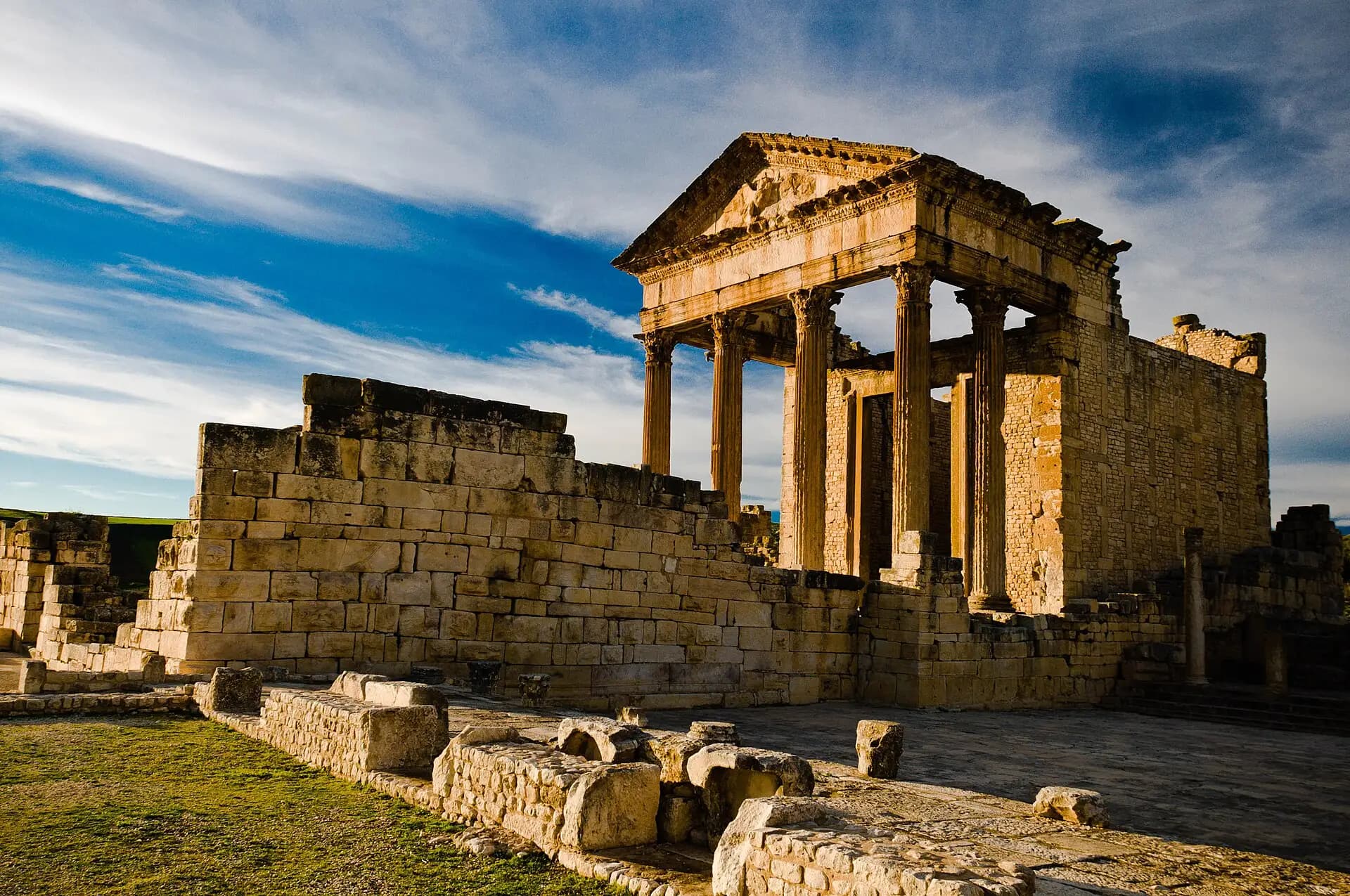
Dougga is widely described as the best-preserved Roman small town in North Africa - a UNESCO World Heritage site draped across a hillside of wheat fields and olive groves in Tunisia's Medjerda valley. It is 20 to 40 minutes by car from Farm El Baya, which makes the farm one of the closest places to spend the night near the site. This guide covers what to see, when to go, and how to turn the visit into a slow weekend rather than a rushed day trip from Tunis.
Why Dougga is worth the trip
Most visitors meet Roman Tunisia at Carthage, where the ruins share space with a modern suburb. Dougga is the opposite: an entire ancient town - streets, temples, houses, baths - left largely intact on its original hillside, with wheat fields below and almost no crowds. UNESCO listed it in 1997 as the best-preserved example of a small Roman town in North Africa.
The city is older than Rome's arrival. It began as Thugga, a Numidian settlement, and that layered history is still legible in the stones - most visibly in the Libyco-Punic mausoleum, one of the very few pre-Roman monuments of its kind still standing anywhere.
What to see on site
The capitol is the postcard: a temple dedicated to Jupiter, Juno, and Minerva, raised in the second century AD, its portico still standing proud against the valley. A short walk away, the theatre - built around 168 AD with seating for some 3,500 spectators - remains complete enough that it still hosts performances during the Dougga Festival each July.
Give yourself time beyond the two landmarks. The paved Roman streets lead past the market square, the baths, private houses, and the temple of Juno Caelestis with its crescent-shaped precinct. Many of Dougga's famous mosaics now hang in the Bardo Museum in Tunis, but here the town itself is the exhibit.
When to go and what to bring
Spring and autumn are the sweet spots: green hills and wildflowers from March to May, soft light and harvest colours in October and November. In summer, aim for early morning or the last hours of the day - the site is exposed and shade is scarce.
The grounds are large and the ancient paving is uneven, so wear proper shoes and bring water and a hat. Facilities on site are minimal - part of the charm, but plan for it. Two to three hours covers the main circuit at an unhurried pace.
Getting there from Farm El Baya
The drive from the farm takes 20 to 40 minutes on countryside roads, passing near Teboursouk. If you would rather not navigate, Mahdi can arrange the private Testour and Dougga tour listed with the stay (250 DT / €74 per stay for the whole booking), with a local guide for both places.
Dougga pairs naturally with Testour, the Andalusian town fifteen minutes from the farm, for a full day of history in the Medjerda valley.
Where to stay near Dougga
There are no hotels at the site itself, and most visitors see it in a hurry from Tunis. Staying nearby changes the visit completely. Farm El Baya is a working permaculture farm about half an hour away, with one private room - the Baya Room, from 180 DT per night - farm breakfast in the morning, and rooftop stargazing under the same dark countryside sky the Romans knew.
Photo: Mohamed Amine Abassi, CC BY 2.0, via Wikimedia Commons